
Earnest Money Deposits in Commercial Real Estate: What Every Investor Needs to Know
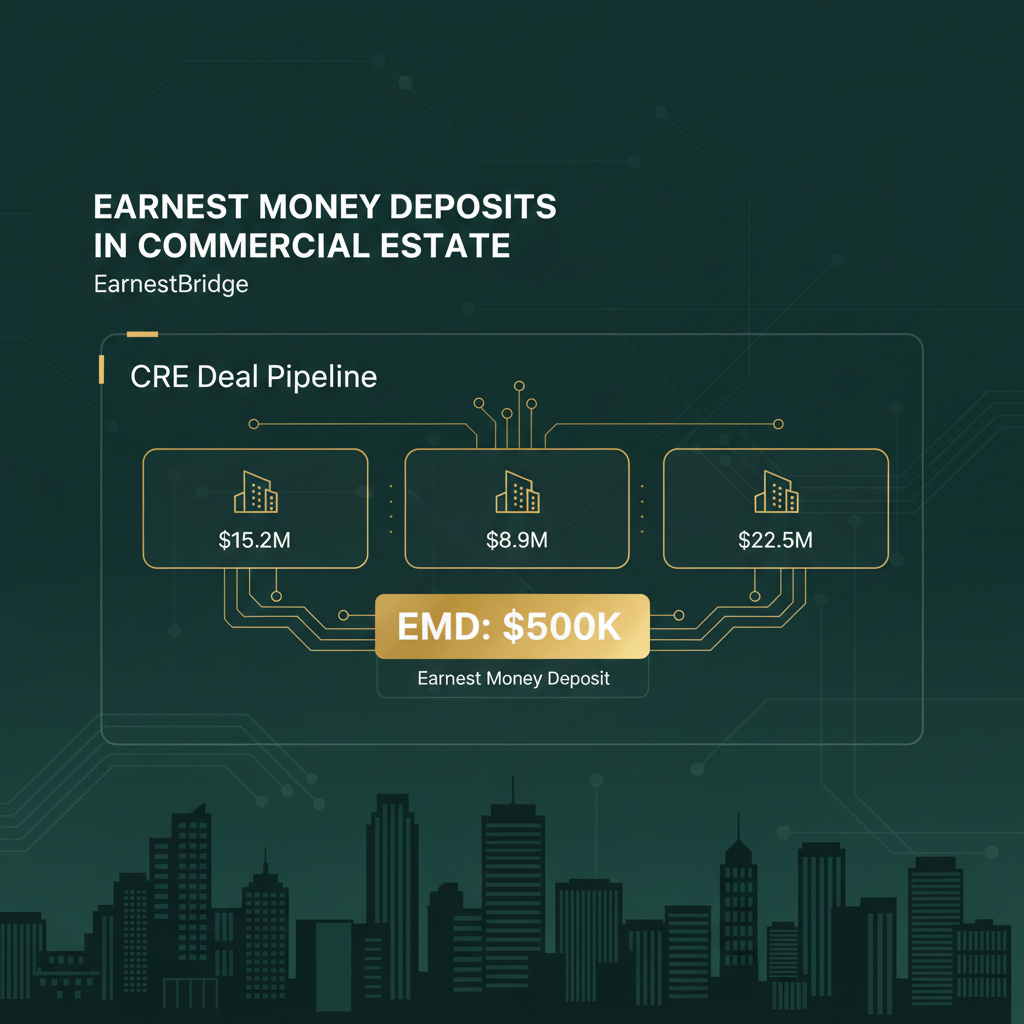
Earnest money deposits in commercial real estate are one of the most significant — and often misunderstood — capital requirements in deal-making. This guide covers everything investors need to know: typical amounts, how deposits are structured, what happens when deals fall through, and how EMD funding can transform your deal pipeline.
What Is an Earnest Money Deposit in Commercial Real Estate?
In commercial real estate, an earnest money deposit (EMD) is a sum of money submitted by the buyer to the seller (held in escrow) at the time of contract execution. It demonstrates the buyer's serious intent to complete the purchase and compensates the seller for taking the property off the market during the due diligence period.
Unlike residential real estate — where earnest money deposits are often a few thousand dollars — commercial real estate deposits are typically much larger, both in absolute terms and as a percentage of the purchase price. This is because commercial transactions involve higher-value assets, longer due diligence periods, and more complex closing processes.
The earnest money deposit serves several critical functions in a commercial real estate transaction:
- →Demonstrates buyer commitment: A substantial deposit signals to the seller that the buyer is serious and financially capable.
- →Compensates seller for exclusivity: The seller takes the property off the market during due diligence. The deposit compensates them for this opportunity cost.
- →Creates buyer accountability: The risk of losing the deposit incentivizes the buyer to complete thorough due diligence and close on schedule.
- →Establishes deal terms: The deposit amount, refundability conditions, and escrow instructions are all specified in the purchase agreement.
Typical EMD Amounts by Property Type
Earnest money deposit requirements vary significantly by property type, market, and deal size. Here's a general guide to what investors can expect:
| Property Type | Typical EMD Range | Example ($10M Deal) |
|---|---|---|
| Office | 1–3% | $100K–$300K |
| Retail | 1–3% | $100K–$300K |
| Industrial / Warehouse | 1–2% | $100K–$200K |
| Multifamily (5+ units) | 1–5% | $100K–$500K |
| Hospitality / Hotel | 2–5% | $200K–$500K |
| Land / Development | 2–10% | $200K–$1M |
| Distressed / Auction | 5–10%+ | $500K–$1M+ |
These are general ranges — actual requirements depend on the specific seller, market conditions, and deal dynamics. In highly competitive markets or for off-market deals, sellers may demand larger deposits to ensure buyer commitment.
For investors pursuing multiple acquisitions simultaneously, these deposit requirements can quickly add up to millions of dollars in capital tied up in escrow accounts — capital that could otherwise be deployed in higher-return uses.
How Earnest Money Works in CRE Transactions
Understanding the mechanics of earnest money in commercial real estate transactions is essential for every investor. Here's how the process typically unfolds:
Letter of Intent (LOI)
Many commercial deals begin with a non-binding LOI that outlines the key terms, including the proposed earnest money deposit amount. Some sellers require a "good faith deposit" with the LOI itself to demonstrate serious intent.
Purchase and Sale Agreement (PSA)
Once the LOI is accepted, the parties negotiate and execute a binding Purchase and Sale Agreement. The PSA specifies the exact deposit amount, the escrow agent, the due diligence period, and the conditions under which the deposit is refundable.
Initial Deposit
Upon PSA execution, the buyer wires the initial earnest money deposit to the escrow agent (typically a title company or attorney trust account). This deposit is usually due within 3–5 business days of PSA signing.
Additional Deposits
Many commercial PSAs require additional "hard money" deposits at specific milestones — for example, at the end of the due diligence period. These additional deposits are typically non-refundable.
Due Diligence Period
During the due diligence period (typically 30–90 days for commercial deals), the buyer conducts inspections, reviews financials, arranges financing, and evaluates the asset. The earnest money is held in escrow throughout this period.
Closing
At closing, the earnest money deposit is released from escrow and applied toward the purchase price. The buyer pays the balance of the purchase price through their primary financing and equity contribution.
Earnest Money vs. Down Payment
One of the most common points of confusion for newer commercial real estate investors is the difference between an earnest money deposit and a down payment. They are distinct concepts:
Earnest Money Deposit
- ✓Submitted at contract signing
- ✓Held in escrow during due diligence
- ✓May be refundable (contingency-dependent)
- ✓Credited toward purchase price at closing
- ✓Typically 1–5% of purchase price
Down Payment
- ✓Paid at closing
- ✓Represents buyer's equity in the deal
- ✓Non-refundable once deal closes
- ✓Separate from (but may include) EMD
- ✓Typically 20–35% of purchase price for CRE
In most commercial real estate transactions, the earnest money deposit is credited toward the down payment at closing. So if you put up a $100,000 EMD on a deal with a $500,000 down payment requirement, you'd only need to bring $400,000 additional equity to closing.
Contingencies and Refundability
Whether your earnest money deposit is refundable depends entirely on the contingencies in your purchase agreement. Understanding these contingencies is critical — they determine your risk exposure.
Common contingencies in commercial real estate PSAs:
Due Diligence Contingency
The buyer has the right to terminate the agreement during the due diligence period for any reason (or no reason) and receive a full refund of the deposit. This is the most buyer-friendly contingency.
Financing Contingency
If the buyer cannot secure financing on acceptable terms, they can terminate the agreement and receive a refund. This protects buyers who are arranging debt financing.
Inspection Contingency
If the property inspection reveals material defects that the seller won't remedy, the buyer can terminate and receive a refund.
Hard Money Deposit (No Contingency)
After the due diligence period ends, many PSAs require an additional "hard money" deposit that is non-refundable regardless of the reason for termination. This is the highest-risk deposit for buyers.
Always have a real estate attorney review your PSA before signing. The specific language around contingencies, deposit refundability, and termination rights varies significantly between deals and markets.
Hard Money vs. Soft Money Deposits
In commercial real estate, you'll often hear the terms "hard money" and "soft money" used to describe different types of earnest money deposits. Understanding the distinction is essential:
Soft Money (Refundable)
Soft money deposits are refundable if the buyer terminates the agreement during the due diligence period. They represent the lowest risk to the buyer.
Hard Money (Non-Refundable)
Hard money deposits are non-refundable regardless of the reason for termination. They're typically required after the due diligence period ends, when the buyer has committed to closing.
Many commercial PSAs use a tiered deposit structure: an initial soft money deposit at signing, followed by a hard money deposit at the end of the due diligence period. This structure protects both parties — the seller gets increasing commitment from the buyer, and the buyer has time to complete due diligence before going hard.
EarnestBridge EMD Program Eligibility
EarnestBridge only supports EMDs while they remain fully refundable. EarnestBridge does not fund hard or non-refundable deposits. If you elect to proceed with the transaction, the option must be exercised by the Option Exercise Deadline and the funded position assumed before the deposit becomes non-refundable. If you decide not to proceed while the EMD remains refundable, the transaction terminates and the refundable deposit returns to EarnestBridge.
The Capital Challenge for CRE Investors
For active commercial real estate investors, earnest money deposits represent one of the most significant capital management challenges in the business. Consider a typical scenario:
Scenario: Active CRE Investor
Over $1 million locked in escrow accounts — earning nothing, unavailable for other uses, and at risk if any deal falls through for a non-contingency reason. For most investors, this level of capital concentration in deposits is unsustainable.
The traditional solution is to pursue fewer deals simultaneously — but this limits deal flow, reduces closing rates, and ultimately constrains portfolio growth. The better solution is EMD funding.
How EMD Funding Solves the Capital Problem
Earnest money deposit funding allows commercial real estate investors to pursue multiple acquisitions simultaneously without tying up their own capital in escrow. EarnestBridge establishes the funded position during the refundable period, allowing the investor's own capital to remain available for the rest of the pipeline. If the investor elects to proceed, the option is exercised and the investor assumes the funded position before the deposit becomes non-refundable.
EarnestBridge is not a lender and the EMD Program is not a debt product. Pricing consists of a $2,500 Administrative Fee plus a Dynamic Deal Fee based on EMD amount, due-diligence timeline, and industry — all disclosed upfront before acceptance into the program.
Here's how EMD funding transforms the scenario above:
With EarnestBridge EMD Funding
Your $1,070,000 in capital remains available for due diligence costs, renovation budgets, closing equity contributions, or additional deal deposits. You're pursuing the same four deals — but with dramatically less capital at risk.
The cost of EMD funding (Administrative Fee + Deal Fee) is a small fraction of the deal value and is far outweighed by the opportunity cost of having capital locked in escrow.
Scaling Your CRE Deal Pipeline with EMD Funding
The most sophisticated commercial real estate investors use EMD funding not just as a capital preservation tool, but as a deal pipeline scaling strategy.
Here's the strategic logic:
Increase deal volume
Without EMD funding, your deal pipeline is limited by how much capital you can afford to have in escrow simultaneously. With EMD funding, you can pursue 3x, 5x, or 10x more deals — dramatically increasing your chances of closing the best opportunities.
Improve offer competitiveness
Larger earnest money deposits signal stronger buyer commitment. With EMD funding, you can offer larger deposits than competitors — making your offer more attractive to sellers without increasing your capital at risk.
Preserve capital for closing
Commercial real estate closings require significant equity contributions. By funding the EMD through EarnestBridge, you preserve your capital for the closing itself — reducing the risk of a deal falling apart due to a capital shortfall at the finish line.
Accelerate portfolio growth
More deals pursued → more deals closed → faster portfolio growth. EMD funding is a force multiplier for active CRE investors.
Real-World Scenarios
Here are illustrative examples of how commercial real estate investors use the EarnestBridge EMD Program:
The Syndicator
A real estate syndicator identifies a $15M multifamily property and needs to secure it with a $300,000 EMD while raising equity from investors. The equity raise will take 45–60 days, but the seller requires the deposit within 5 days.
EarnestBridge establishes the funded position and funds the $300,000 refundable EMD within 48–72 hours. The syndicator secures the property and completes the equity raise during the due-diligence period. When the syndicator elects to proceed, the option is exercised by the Option Exercise Deadline and the syndicator assumes the funded position before the deposit becomes non-refundable.
The Portfolio Builder
An investor is simultaneously pursuing three industrial properties in different markets. Each requires a 2% EMD — totaling $450,000 in deposits. The investor doesn't want to tie up that much capital across three deals that may or may not close.
EarnestBridge funds all three refundable EMDs. The investor pursues all three deals simultaneously. Two proceed — the investor exercises the option and assumes the funded position on each before the deposits become non-refundable. The third is terminated while the EMD remains refundable, and the deposit returns to EarnestBridge. Total cost: the Administrative Fee and Deal Fee on the two deals that proceeded — a fraction of the deal value.
The Value-Add Buyer
A value-add investor is buying a distressed office building that requires a 5% EMD ($250,000) plus a significant renovation budget at closing. Tying up $250,000 in escrow would strain their renovation capital.
EarnestBridge funds the $250,000 refundable EMD. The investor preserves their capital for the renovation. When the investor elects to proceed, the option is exercised and the investor assumes the funded position before the deposit becomes non-refundable.
Frequently Asked Questions
How much is a typical earnest money deposit in commercial real estate?+
Is earnest money refundable in commercial real estate?+
What is the difference between earnest money and a down payment?+
Can I use the EarnestBridge EMD Program for commercial real estate?+
How long is earnest money held in escrow for commercial real estate?+
The Takeaway for CRE Investors
Earnest money deposits are an unavoidable part of commercial real estate deal-making. Understanding how they work — typical amounts, contingency structures, hard vs. soft money mechanics — is fundamental to operating effectively in the CRE market.
But the most sophisticated investors go one step further: they use the EarnestBridge EMD Program to decouple their deal pipeline from their capital constraints. By funding deposits through EarnestBridge during the refundable period, they can pursue more deals, move faster, and preserve capital for the uses that generate the highest returns.
If you're a commercial real estate investor looking to scale your deal pipeline without tying up capital in escrow, contact EarnestBridge today.
Continue Reading
Fund Your Next CRE Deal
Stop letting capital constraints limit your deal pipeline. EarnestBridge funds your refundable earnest money deposit in 48–72 hours — no personal guarantee, no equity surrendered.
Share this article