
The $40,000 Difference: Why Equity Splits Are Killing Your Scalability
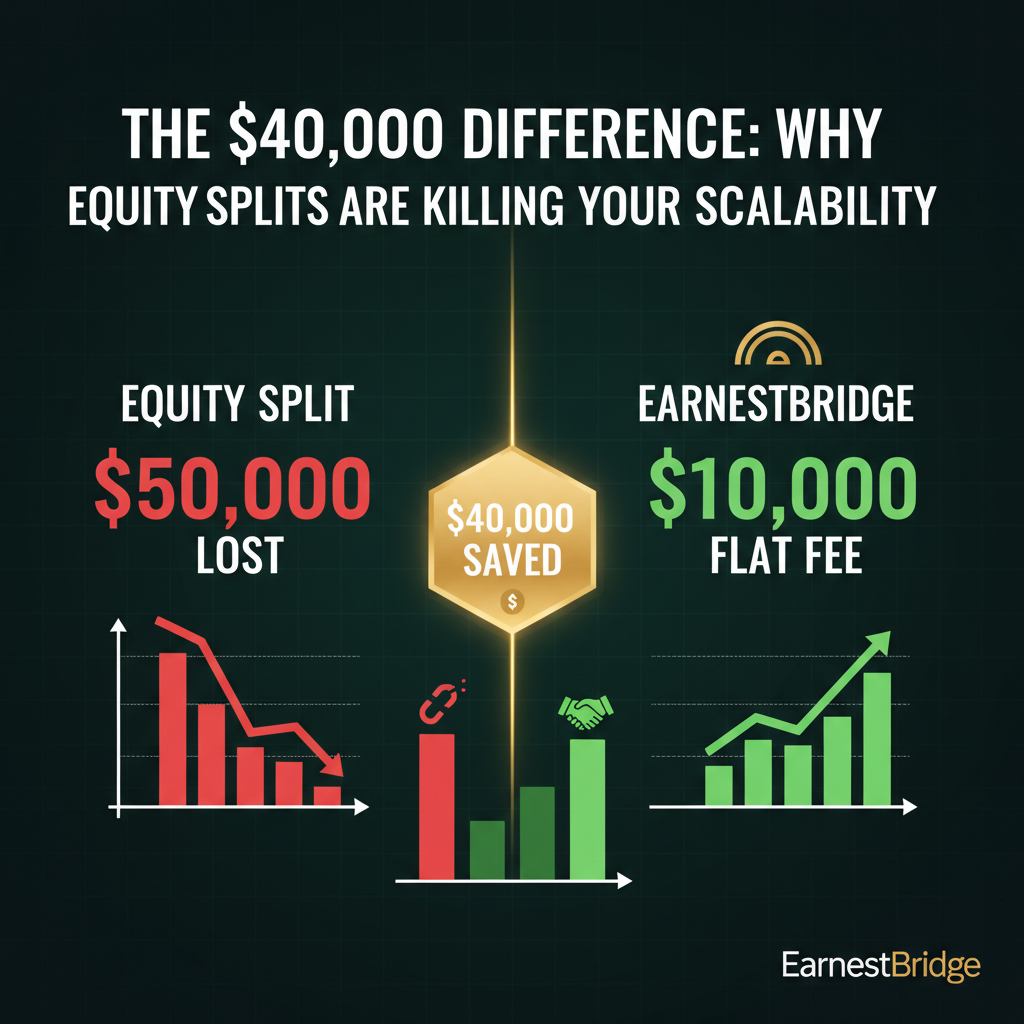
In the world of high-volume real estate, the Earnest Money Deposit (EMD) is the gatekeeper. Whether you're locking up a commercial complex or a massive residential portfolio, a $250,000 EMD is a heavy lift. When you don't want to tie up your own liquidity, you have two choices: equity partners or a purpose-built EMD solution. One feels "free" upfront — but costs you a fortune at the closing table.
The Scenario: The $250,000 EMD
Illustrative Example: The transaction below is a hypothetical example using representative deal economics to demonstrate the difference between permanent equity dilution and the EarnestBridge Service Fee. The Estimated Service Fee shown is for illustration only and is not a quote. Actual Service Fees are dynamically calculated based on EMD amount and due-diligence period, and may also depend on industry, transaction structure and other deal-specific factors. Final pricing is disclosed upfront before acceptance into the EMD Program.
You've found a Tier-1 deal. The EMD is $250,000. The expected profit on the flip or assignment is $100,000. You need the capital for 30 days to clear due diligence and get to the finish line.
You don't want to tie up your own liquidity — you have other deals in the pipeline. So you look at your two options for sourcing the deposit capital.
Let's look at the economics of each option in this hypothetical scenario.
Option A: The Equity Split (The "Gator" Model)
Many EMD funders operate on a "50/50" or "Profit Share" model. They put up the cash, and in exchange, they take a massive bite of your hard-earned upside.
The reality: You did 100% of the sourcing, 100% of the negotiation, and 100% of the legwork — but you only took home half the check. A temporary EMD need created a permanent economic cost.
Option B: The EarnestBridge EMD Program
EarnestBridge is not a lender and the EMD Program is not a debt product. EarnestBridge establishes the funded buyer position during the fully refundable period and provides the client an option to assume that position if they choose to proceed. There is no equity surrendered to EarnestBridge and no personal guarantee.
EarnestBridge supports only EMDs that remain fully refundable during the applicable due-diligence / option period. EarnestBridge does not fund hard or non-refundable deposits.
For the hypothetical transaction described above, the illustrative Estimated Service Fee used in this example is:
This $10,000 figure is an illustrative Estimated Service Fee for this hypothetical scenario only. It is not a quote or guaranteed price. See the Actual EarnestBridge Pricing section below.
Actual EarnestBridge Pricing
The $10,000 figure above is used only to illustrate the hypothetical example in this article. Actual EarnestBridge pricing works as follows:
Final pricing is disclosed upfront before acceptance into the EMD Program. Do not rely on the illustrative $10,000 figure above as an estimate for your transaction.
The Verdict: The $40,000 Illustrative Difference
In the hypothetical scenario described above, the illustrative difference between the two options is $40,000. Here's the side-by-side breakdown for that specific example:
Note: These figures apply only to the hypothetical transaction described in this article. Actual EarnestBridge Service Fees vary by transaction.
| Fee Structure | Total Cost | Your Take-Home |
|---|---|---|
| Equity Split (50%) — Hypothetical | $50,000 | $50,000 |
| EarnestBridge — Illustrative Example | $10,000 | $90,000 |
The EarnestBridge Advantage
Stop treating your EMD as a partnership and start treating it as a transaction-specific capital need. When you pay a disclosed Service Fee — rather than giving away your upside permanently — you gain the ability to scale your business without diluting your wealth.
Transparent, Upfront Pricing
You know your exact cost before you accept. No surprises. The Service Fee is disclosed upfront before acceptance into the EMD Program and is payable upon agreement acceptance, before EMD funding.
You Keep Your Equity
EarnestBridge has zero interest in your deal profit. No equity is surrendered to EarnestBridge. Your upside is yours.
No Personal Guarantee Required
EarnestBridge qualifies the deal — not you. No credit check, no income verification, no personal financial statements, no personal debt obligation.
Speed That Matches Deal Flow
Funding in 48–72 hours means you can move at the speed of the deal — not the speed of a partner's approval process or capital call timeline.
Why This Matters for Scalability
The $40,000 illustrative difference on a single hypothetical deal is significant. But the real impact compounds as your deal volume grows.
If the same hypothetical economics were repeated across 10 comparable transactions, the equity split model would cost $500,000 in surrendered profit, while the illustrative EarnestBridge program cost would total $100,000 — an illustrative difference of $400,000 across those 10 hypothetical deals.
These projections are hypothetical and based solely on repeating the illustrative example assumptions above. Actual EarnestBridge fees and deal results vary by transaction.
That's not just a cost savings — it's the difference between a deal-maker who is slowly diluting their wealth with every transaction and one who is compounding it.
The math-minded investor understands that every dollar surrendered to an equity split is a dollar that can't be reinvested, can't fund the next deal, and can't build the business. A temporary EMD need should not create a permanent economic cost.
Frequently Asked Questions
What is an equity split EMD funder?+
How does EarnestBridge pricing compare to a 50/50 equity split?+
Is the EarnestBridge EMD Program a debt product?+
Why do equity splits hurt real estate scalability?+
Does EarnestBridge require a personal guarantee or credit check?+
The Bottom Line
A "free" deposit isn't free. When an equity split funder takes 50% of your profit, you're paying the most expensive form of short-term capital in the market — you just don't see the bill until the deal closes.
EarnestBridge was built for the math-minded investor who understands that a temporary EMD need should not create a permanent economic cost. The EMD Program keeps your equity intact, your costs disclosed upfront, and your deal economics working in your favor — on every transaction.
Don't let a "free" deposit cost you your biggest payday of the year. Apply for funding today and get your pricing disclosed before you sign.
Ready to Keep Your Equity?
Get your pricing disclosed upfront before you sign. No equity splits. No personal guarantee. Refundable EMDs only.
Continue Reading
Share this article