
The Hidden Cost of Waiting for Your Own Capital to Free Up
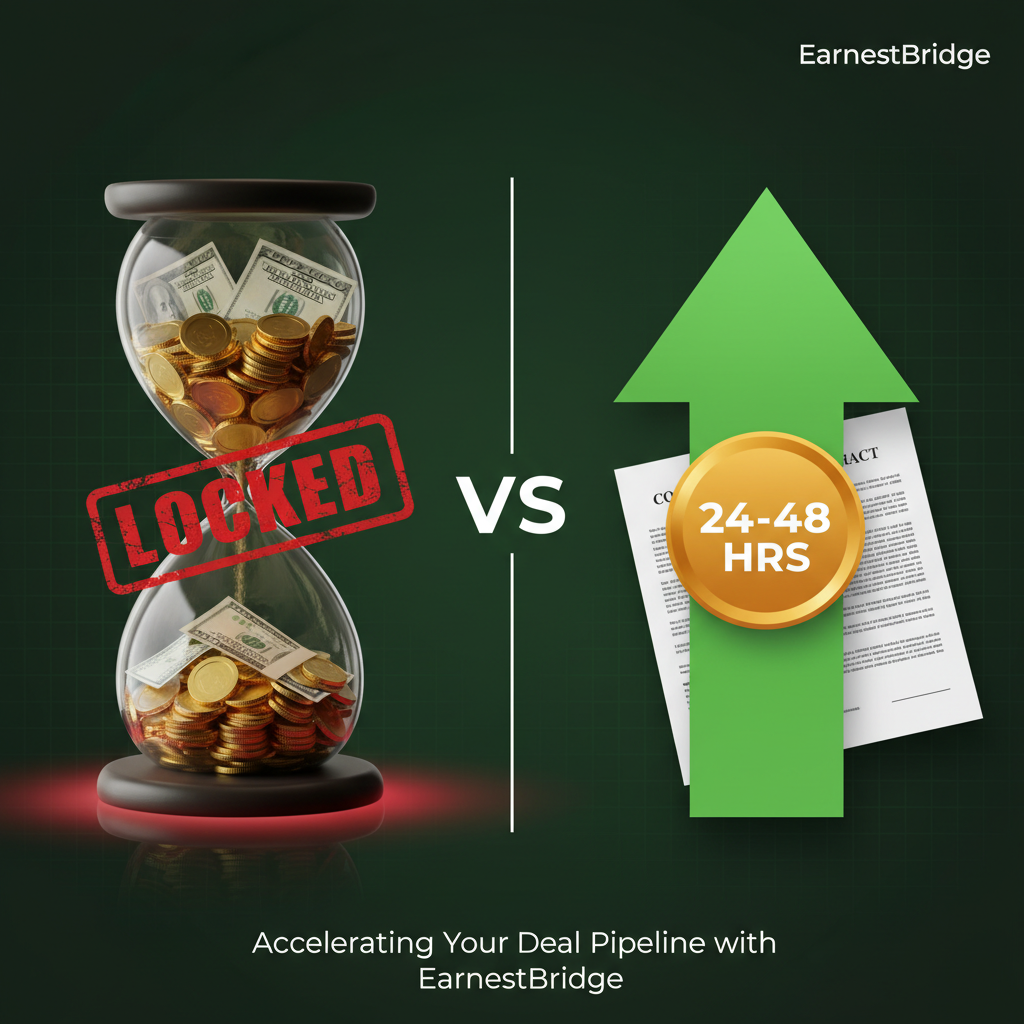
You've found a strong deal. The numbers work. The seller is ready to sign. But your cash is still tied up in two other contracts that won't close for another 30–45 days. So you wait. That waiting feels conservative. It feels responsible. In reality, it is one of the most expensive habits in deal-making.
The Real Price of "Waiting for Capital"
Most deal-makers think about the cost of EMD funding only in terms of fees. They compare the cost of the EarnestBridge EMD Program or other EMD solutions against the cost of using their own cash. What they miss is the opportunity cost of time.
Every day you delay posting an earnest money deposit is a day the asset can go under contract with someone else — and a day your capital remains frozen in places that generate zero return. The cost is rarely visible on a spreadsheet, but it shows up in lost deals, slower pipeline velocity, and lower annual production.
Consider a typical commercial real estate scenario:
Your capital is currently locked in another deal that is 20 days from closing. You decide to wait those 20 days so you can use your own money for the new EMD. During those 20 days:
- ✕A competing buyer submits a stronger offer and the seller accepts it.
- ✕You lose the $275,000 profit opportunity.
- ✕Your original capital still sits in escrow earning nothing.
Even if you eventually win the next deal that comes along, you have permanently lost the velocity. Over a year of similar delays, the compounding effect is significant.
Opportunity Cost in Plain Numbers
The disclosed EarnestBridge Service Fee is a fraction of the profit you protect by moving at deal speed.
| Scenario | Outcome | Net Result |
|---|---|---|
| Wait for own capital (20-day delay) | Lose the deal | $0 profit + capital still locked |
| Use EarnestBridge EMD Program immediately | Secure the deal | Deal secured; potential upside preserved, less the disclosed EarnestBridge Service Fee applicable to that transaction. |
| Difference | — | Substantial retained upside vs. zero |
The Fastest Way to Get EMD Funding for Commercial Real Estate
Speed is the primary reason deal-makers turn to specialized EMD solutions. Traditional banks and lines of credit are not built for this use case. They require personal financial statements, credit checks, and multi-week underwriting. By the time approval arrives, the deal is often gone.
Purpose-built EMD programs work differently:
Eligibility: EarnestBridge supports only EMDs that remain fully refundable during the applicable due-diligence / option period. EarnestBridge does not fund hard or non-refundable deposits.
This is why deal-makers looking for fast, capital-efficient EMD solutions consistently turn to specialized programs rather than conventional financing sources.
EMD Funding vs. Waiting: Side-by-Side Reality Check
The decision is rarely about whether you can wait. It is about whether the cost of waiting is worth more than the cost of a professional EMD solution.
| Factor | Waiting for Own Capital | Professional EMD Funding |
|---|---|---|
| Time to secure deal | Days to weeks | 48–72 hours |
| Capital locked elsewhere | Yes | No |
| Ability to pursue multiple deals | Limited | High |
| Equity dilution | None | None |
| Predictable cost | Opportunity cost (often large) | Service Fee disclosed upfront, before acceptance |
| Risk if deal falls through | Full deposit at risk | Structured according to contract contingencies |
What About Wholesale Deals?
A common related question is: "Do you need earnest money in a wholesale deal?"
In most wholesale transactions the deposit is smaller, but the principle remains the same. Sellers and end-buyers still expect a meaningful deposit to demonstrate seriousness. Waiting for capital to free up can still cost you the assignment — especially when multiple wholesalers are competing for the same contract.
The same speed and capital-efficiency logic applies, just at a different scale.
How EarnestBridge Solves the Waiting Problem
EarnestBridge is not a lender and the EMD Program is not a debt product. EarnestBridge was built specifically for deal-makers who refuse to let capital constraints dictate their pipeline. EarnestBridge establishes the funded buyer position during the fully refundable period and provides the client an option to assume that position if they choose to proceed.
The program covers earnest money deposits across commercial real estate and other high-value verticals with a simple, transparent structure:
Your capital stays free to work on the rest of your pipeline. And you stop paying the invisible tax of delayed decision-making.
The Bottom Line
Waiting for your own capital to free up feels safe. In practice, it is one of the most expensive strategies a high-volume deal-maker can adopt.
The true cost is not the Service Fee on EMD funding — it is the deals you never get under contract, the pipeline velocity you never achieve, and the compounding production you leave on the table.
The fastest, cleanest solution is a purpose-built EMD program that treats the deposit as a short-term capital need rather than a reason to freeze your business.
Stop letting capital timing cost you contracts.
Ready to fund your next EMD without waiting? Submit your deal and receive a funding decision — typically within a few business hours.
Submit Your Deal→Frequently Asked Questions
What is the fastest way to get earnest money deposit funding for commercial real estate?
Specialized EMD solutions like the EarnestBridge EMD Program typically fund within 48–72 hours of a complete deal submission. Traditional banks and lines of credit usually take significantly longer and are not designed for this use case.
Is the EarnestBridge EMD Program a debt product?
No. EarnestBridge is not a lender and the EMD Program is not a debt product. EarnestBridge establishes the funded position during the refundable period and provides the client an option to assume that position if they choose to proceed.
Do I still need earnest money in a wholesale deal?
Most wholesale contracts still require a deposit to demonstrate seriousness and secure the assignment rights, though the amount is often smaller than in traditional acquisitions.
Does EarnestBridge take equity or require a personal guarantee?
No. EarnestBridge does not take equity and does not require a personal guarantee. Qualification is based on the deal — not the individual. There is no equity split and no personal debt obligation.
Share this article